From Rule to Atmosphere: Binary Distinctions are just Surfaces of Overlapping Relational Fields.
Joseph Macke
Art and Science Conductor, HEKA Studio
An Evolution of Rules is imminent
Our systems are built on rules. What exactly are rules? Rules define. Rules establish what ought to be done. Rules are therefore intended to guide behaviour. They are meant to shape reality and bring it into line with the wishes of those who draw them up. They define what is allowed and what is forbidden. They anticipate behavior and respond to deviation. If a rule is broken, a sanction follows. If a rule is followed, order is maintained (Kelsen, H. (1960), p. 4 ff., 34–40).
At their core, these systems rely on a simple structure: Yes or no. Allowed or forbidden. With that, it is not far from delving into binary code: 1 or 0 (Shannon, C. E. (1948), 379–423; Luhmann, N. (1984), p. 191 ff.). It is a binary code, an algorithm. But is that really a model capable of capturing the countless interplay and depths of reality?
The Logic of the Binary is a Surface
It reminds me of colour theory: A comparable shift can be observed in how we describe color. At first glance, color appears as a set of distinct categories. Red is not blue. Green is not yellow. But this distinction only holds on the surface. Once again, the aim here is to delve deeper. In color theory, these categories dissolve into continuous spaces. Color is no longer defined by fixed boundaries, but by position within a field. Different color models such as RGB, CMYK, or CIELAB do not describe isolated values, but relational coordinates within multidimensional spaces.
What appears as a clear distinction is in fact the result of overlapping gradients. There is no absolute point where red ends and orange begins. Only transitions, shifts, and relational differences. The logic changes. From discrete units to continuous variation. From classification to position (coordinates). From binary code to field. What color theory reveals is not an exception, but a structural principle. The world does not consist of clearly separable units, but of relational configurations that only appear stable when reduced to simplified codes.
From Distinction to Continuum
Yet the above mentioned binary logic is deeply embedded in how we organize the world. It appears in legal systems, in digital infrastructures, in administrative processes. It is efficient. It is clear. It produces decisions, therefor the next step. It creates future, a path. Language itself often follows this logic: A statement is accepted or rejected. A command is executed or refused. As if meaning could be stabilized through a sequence of correct and incorrect moves (Wittgenstein, L. (1953), §§23, 138; Lyotard, J.-F. (1984), p. xxiv-xxv).
But isn’t that a bit too simplistic? This meandering along a path that offers only two options, two alternatives, at every intersection?
This is not how we actually move through the world (Merleau-Ponty, M. (1962), S. 145 ff.). We do not enter a space and first ask which rule applies. We sense it. A room can feel tense, open, cold, inviting. A landscape can calm or unsettle. A situation can allow for certain actions while quietly excluding others. Before we decide how to act, we are already situated within a field that shapes what feels possible (Böhme, G. (1995), S. 22-29).
This implies that our understanding of the decision-making process is preceded by something that lies in the realm of emotion and feeling.
This field precedes any decision. It is not something we enter consciously. It is what already holds us. What we call a “decision” often appears only afterwards, as a secondary articulation of a prior orientation. Before we judge, before we choose, we are already attuned. Mood does not follow perception. It makes perception possible. It opens a world in advance, not by determining what is, but by shaping what can appear at all. What seems like individual agency is therefore always already embedded in a pre-individual field that orients action without commanding it. (Han, B.-C. (2017), p. 26–32; (2014), p. 11–15).
Intersections become node points, and the path of alternatives becomes a field of possibilities.
From Code to Field(s)
This field cannot be reduced to a binary code. It does not operate through yes or no. It does not resolve into 1 or 0. It is continuous, shifting, and often ambiguous. It is atmosphere (Böhme, G. (1995), S. 35 ff.; Latour, B. (2005), p. 63 ff.). It is misty, unclear. It shifts as we try to make sense of it. It cannot be cut, divided or structured. We stand there with our razor blades (Ockham), but soon realise that we are trying to cut through air, through light and scent. Just when we think we have finally captured it in our focus, ready to contain it, it escapes us once again (Macke, J. (2025)).
This field is not only functional. It is imaginal. It does not simply structure behavior, it generates images. Not as representations, but as lived realities. To enter such a field is not to interpret it, but to dwell within it. Images here are not symbols to be decoded. They are events that unfold. They carry their own logic, one that does not reduce to explanation, but expands into experience. A space does not communicate what it means. It produces a world that can be inhabited. (Bachelard, G. (1960), p. 1–15; (1958), p. xxxv–xxxvii)
Language, too, (fortunately) exceeds the logic of command. Not every utterance is an instruction. Not every exchange can be reduced to execution or refusal. Meaning emerges in use, in context, in relation. It cannot always be fixed in advance (Wittgenstein, L. (1953), § 43; Lyotard, J.-F. (1988), p. xi-xiii). Not everything can always be either right or wrong, either true or false, either right or left. The binary system is too simplistic to capture the nuances of reality. We need to try again to create a new ‘system of order’. Two tentative hints are already present in that last sentence:
Firstly, it can only ever be an attempt, with no claim to truth, but perhaps a small step closer to the idea of truth. Secondly, ‘system of order’ is in quotation marks. The concept of order is, after all, relative and human. Must everything be in order? For whom is there order? For those who can pigeonhole it into the most abstract categories possible? Those who, once again, fall back into patterns of right and left, black and white? A new kind of ‘system of order’ must not make these very mistakes, this deceptive arrogance that the human mind could impose its categories on the world. It is not that simple. Fortunately. The world lies out there like an ocean, and yet it is within us. We are constantly and perpetually integrating ourselves into it, and it into us.
Rules attempt to stabilize behavior from the outside (again in itself the wrong distinction on the edge of a border between inside and outside). They assume that action can be guided through clear distinctions and enforceable consequences. We think we can cut the waves in pieces and direct them into our breakwaters.
Atmospheres operate differently. They do not command. They do not decide. They orient (Böhme, G. (1995), S. 45; Han, B.-C. (2014), p. 20 ff.).
It is not about taming the waves; it is about understanding them and accepting our place among them. Where rules produce decisions, atmospheres produce tendencies. Where rules require enforcement, atmospheres unfold through resonance. They do not tell us what to do. They shape what becomes possible (Han, B.-C. (2017), p. 34-36). This difference becomes visible where systems reach their limits. In complex environments, in ecological processes, in social situations that cannot be reduced to predefined paths, binary logic begins to fail (Morin, E. (2008), p. 15-22; Latour, B. (2005)).
We can already see the limitations of algorithmic classification. The first AI bubbles already seem to be bursting, which can be quite revealing. This could serve as confirmation of the above approach: that the world simply cannot be reduced to binary code. Reality does not follow a yes-or-no structure. It unfolds in gradients, overlaps, and relations that cannot be cleanly separated (Deleuze, G. (1994), p. 222-230).
An Example from Indigenous Philosophy
What appears as a binary distinction is often only the surface of multiple overlapping classifications that cannot be reduced to a single code. A comparable structure can be observed in ethnographic accounts of classification. In his study of the Cashinahua, Kenneth Kensinger describes how categories such as “real” and “unreal” do not form a single binary opposition, but emerge from multiple overlapping polarities (1995), pp. 83–90).
Rather than dividing the world into two fixed domains, classification operates through several relational axes that intersect without collapsing into a unified system. The same entity can belong to different categories depending on context, use, or perspective. What appears as a contradiction within a binary framework becomes consistent within a relational one. There is no stable boundary that definitively separates one category from another. Instead, there are shifting zones of overlap, gradation, and negotiation. Classification here does not produce clear distinctions.
It produces a field. What this reveals is not cultural exception, but structural insight:
binary distinctions are often only the visible surface of a far more complex, multi-dimensional ordering that resists reduction to a single code. We need to understand this in order to form a multidimensional picture of reality, rather than remaining stuck in our one-dimensional, binary framework.
Opposites do not necessarily exclude each other. They can coexist within a single configuration. In such constellations, meaning does not arise by eliminating one side, but by sustaining the relation between them. The attempt to resolve ambiguity into a single value destroys precisely what makes the situation intelligible. Ambivalence is not a failure of clarity. It is a condition of reality. (Jung, C. G. (1951), §13–19). Ambivalence is a space of possibility, a field of tension (see Han, B.-C. (2022)) that must be endured, for it is only here that we retain the opportunity to explore different chances without burning our bridges.
From Absolute to Relational Orders
If we continue to organize the world through binary codes alone, we risk losing what cannot be encoded. Relations become invisible. Ambiguity becomes a problem. Complexity is reduced to error (Lyotard, J.-F. (1984); Han, B.-C. (2017)).
What appears instead is not disorder, but another kind of structure. One that does not rely on fixed commands, but on situated relations. One that does not begin with decision, but with condition (Latour, B. (2017), p. 92-100). If behavior emerges within a field, then responsibility does not belong solely to the individual who acts. That is the key point, which is why it is worth repeating. Responsibility does not lie with the individual (neither in the positive nor in the negative sense of the term). It is distributed. It is distributed across relations. Across humans and non-humans. Across visible structures and invisible conditions. Action is not the output of a single actor. It is the effect of a network.
To act means to be situated within a web of dependencies that both enable and constrain what becomes possible. What appears as an individual decision is always already a collective configuration. Between people. Between humans and environments. Between visible and invisible forces (Latour, B. (2005), p. 72-75; Ingold, T. (2011), p. 63-70).
This shift has consequences. The law often focuses on individual behaviour, for example in matters of causality and objective attribution, as well as the question of guilt in criminal law. As well do systems built on binary decisions and forms of organization that depend on clarity and control (Kelsen, H. (1960); Han, B.-C. (2014)).
Designing Conditions
A different practice begins here. Not by abandoning rules, but by recognizing their limits. And by asking: What are the conditions in which actions emerge? What kind of atmosphere produces care? What kind of atmosphere produces extraction (Böhme, G. (1995); Ingold, T. (2011))? How can we broaden existing legal concepts to incorporate this context, namely, the environment, the background, the “field” in which an action takes place? How can the law and our forms of organization / our systems become more multi-layered, rather than a one-dimensional snapshot? How can we make them more flexible without creating uncertainty?
Within HEKA, these questions are not treated as abstractions. They are translated into spatial situations. Environments in which relations become tangible. In which behavior is not instructed, but emerges (McCall, A. (2004)).
The question is no longer how to define the correct rule. The question becomes: What is the field in which we act? And how is it shaped (Latour, B. (2005))?
These fields are not static. They circulate. Affect moves between bodies, between spaces, between situations. What is felt is not contained within the individual, but transmitted. Atmosphere is not an abstraction. It is a material exchange. What we experience as a mood may already belong to the space we have entered. (Brennan, T. (2004), p. 1–10).
If we begin from here, law, language, and design shift. They no longer operate only through commands and decisions. They begin to work on the conditions that make actions possible in the first place (Lyotard, J.-F. (1988); Böhme, G. (1995); Latour, B. (2005)). We have spent long enough studying plants, but have forgotten to take the soil and the weather into account. We need to take this step further, and we must do so for the ‘plant’ language as well as for the ‘plant’ law and the ‘plant’ system.
And perhaps this is where a different form of thinking starts. Not in the certainty of yes or no. But in the space in between.
We do not encounter the world as something fully given. We construct it through perception, through sensation, through imagination. What we experience as reality is inseparable from how we feel it. There is no stable ground beneath this. Only layers of interpretation that become real through repetition. The field we inhabit is therefore not external to us. It is continuously produced in the relation between sensing and world.
References
Bachelard, Gaston (1958). The Poetics of Space. Boston: Beacon Press.
Bachelard, Gaston (1960). The Poetics of Reverie. Boston: Beacon Press.
Böhme, Gernot (1995). Atmosphäre: Essays zur neuen Ästhetik. Frankfurt am Main: Suhrkamp.
Brennan, Teresa (2004). The Transmission of Affect. Ithaca: Cornell University Press.
Deleuze, Gilles (1994). Difference and Repetition. New York: Columbia University Press.
Jung, Carl Gustav (1951). Aion: Researches into the Phenomenology of the Self. Princeton: Princeton University Press.
Han, Byung-Chul (2014). Psychopolitics: Neoliberalism and New Technologies of Power. London: Verso.
Han, Byung-Chul (2017). In the Swarm: Digital Prospects. Cambridge: MIT Press.
Han, Byung-Chul (2022). The Spirit of Hope. Cambridge: Polity.
Ingold, Tim (2011). Being Alive: Essays on Movement, Knowledge and Description. London: Routledge.
Kelsen, Hans (1960). Reine Rechtslehre. Wien: Franz Deuticke.
Kensinger, Kenneth (1995). How Real People Ought to Live: The Cashinahua of Eastern Peru. Prospect Heights: Waveland Press.
Latour, Bruno (2005). Reassembling the Social: An Introduction to Actor-Network-Theory. Oxford: Oxford University Press.
Latour, Bruno (2017). Facing Gaia: Eight Lectures on the New Climatic Regime. Cambridge: Polity Press.
Luhmann, Niklas (1984). Soziale Systeme. Frankfurt am Main: Suhrkamp.
Lyotard, Jean-François (1984). The Postmodern Condition: A Report on Knowledge. Minneapolis: University of Minnesota Press.
Lyotard, Jean-François (1988). The Differend: Phrases in Dispute. Minneapolis: University of Minnesota Press.
Macke, Joseph (2025). Out of Focus. (Link)
McCall, Anthony (2004). Line Describing a Cone.
Merleau-Ponty, Maurice (1962). Phenomenology of Perception. London: Routledge.
Morin, Edgar (2008). On Complexity. Cresskill: Hampton Press.
Shannon, Claude E. (1948). A Mathematical Theory of Communication. Bell System Technical Journal, 27(3), 379–423.
Wittgenstein, Ludwig (1953). Philosophical Investigations. Oxford: Blackwell.
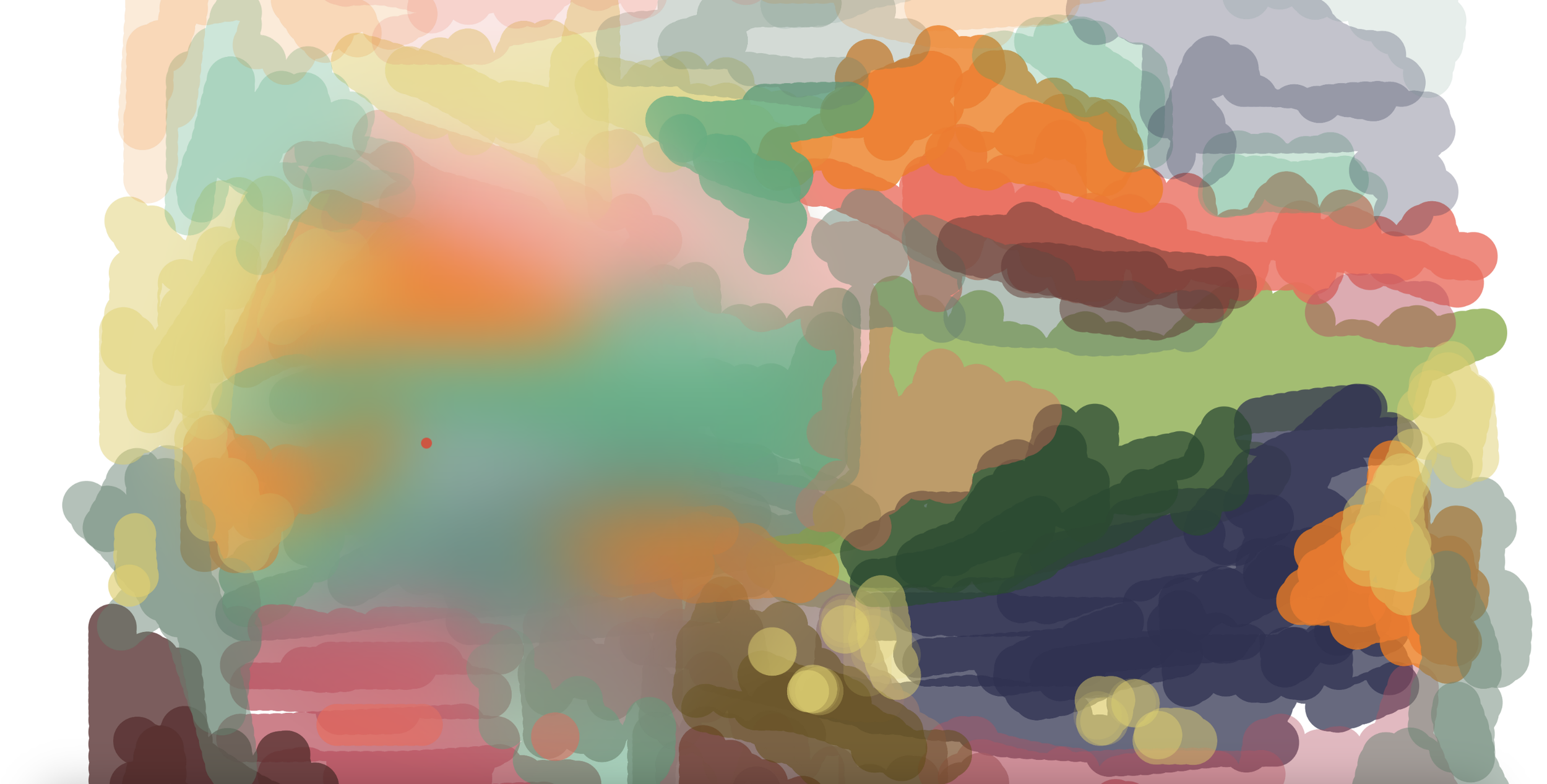
Macke, "Out of focus", 2025, digital (Link)