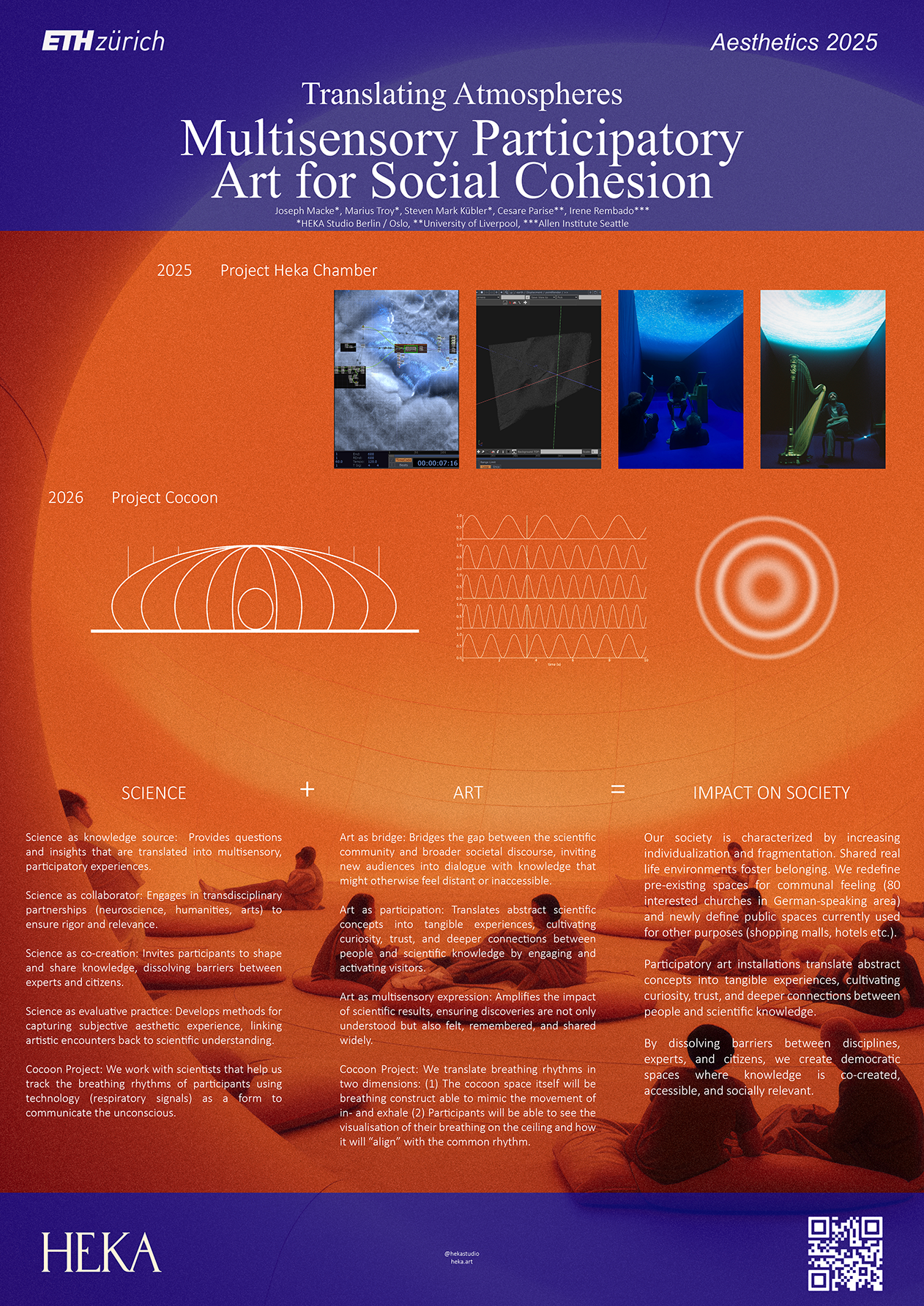
Translating atmospheres: Multisensory art as a catalyst for aesthetic experience & social cohesion
ETH Zurich conference on Aesthetics 2025 (Link)
Joseph Macke*, Marius Troy*, Steven Mark Kübler*, Cesare Parise**, Irene Rembado***
*HEKA Reasen, Berlin, Germany / Oslo, Norway, **University of Liverpool, UK ***Allen Institute, Seattle, USA
This community-based project investigates how multisensory participatory art can strengthen social bonds and enrich aesthetic experience in diverse public settings. By integrating visual, auditory, and haptic modalities, these practices cultivate atmospheres, affective environments understood as real and shaping forces, drawing on the work of Böhme, Sloterdijk, Pallasmaa, and Zumthor.
These atmospheres do more than modulate perception; they carry societal and political significance by fostering collective presence, reimagining public space, and enabling more inclusive and empathetic modes of interaction. Central to our approach is the emphasis on haptic perception as the first and most primal human sensory modality and as a means of intuitive, non-verbal engagement. We hypothesize that tactile interaction enhances cognitive and affective dimensions of aesthetic experience, particularly across cultural and linguistic boundaries.
Since the Enlightenment, Western thought has privileged logic and reason as the dominant frameworks for knowledge production. While this orientation has yielded significant advancements, it often sidelines other vital epistemologies, namely those grounded in emotion, embodiment, and sensory experience. In response to growing societal disconnection and digital abstraction, this project offers a counterpoint: advancing social cohesion and civic resilience through artistic experimentation and sensory research.
Our studio positions itself as a translator, an interface that bridges increasingly divided domains such as the spiritual, scientific, political, and cultural spheres. Through immersive installations and participatory methods, we seek to transform abstract inquiry into tangible, shared experiences that invite critical reflection. Drawing from AI-generated design processes and transdisciplinary collaboration, we provide formats through which research can become sensorially accessible and socially resonant.
We warmly invite researchers from the sciences, humanities, and beyond to join this evolving initiative. Together, we aim to build a living, interdisciplinary community that is capable of shaping public discourse and generating new ways of understanding and engaging with the world. The project also reflects on methodological questions around capturing subjective aesthetic experience in public art contexts, offering insights for future interdisciplinary study design. Its long-term impact is sustained through digital documentation and the evaluation of participatory outcomes.
This presentation contributes to the growing dialogue on how multisensory artistic practices can bridge the gap between scientific inquiry and socially grounded action.