When Biology Reveals Its Invisible Beauty: Microscopy, aesthetics, and awe at the limits of perception
Irene Rembado
Senior Scientist, Brain and Consciousness | Allen Institute | Scientific Advisory Board, HEKA Studio
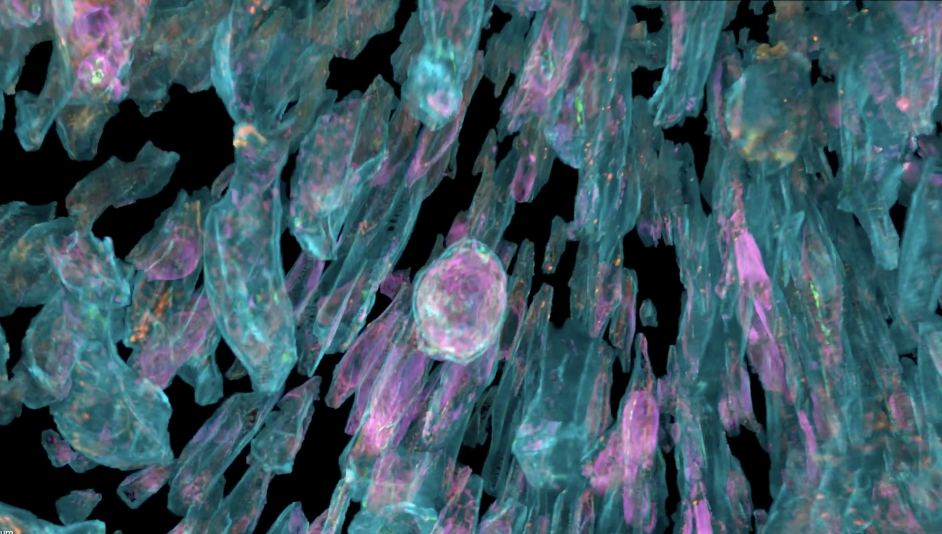
Biology is beautiful! And everybody working at the HHMI Janelia Research Campus knows it. It is enough to walk close to any of the internal walls anywhere on campus to get a taste of it. This is because large prints of images collected by Janelia researchers are showcased and proudly kept alive throughout the building. Janelia’s worldwide recognition for innovations in microscopy equips scientists with highly advanced technological tools, allowing them to capture the beauty of the largely invisible biological world.
Thankfully, a physical visit to the center is not required in order to access the aesthetic experience these images trigger. In fact, anyone can access this collection from the comfort of their own home by visiting the HHMI Beautiful Biology website. Created with the sole intention of cultivating interest in biology, this website is a unique resource on the biological world, providing organized and curated material for educational purposes. But not only that — it is also a highly entertaining visual experience. By exploring the collection, the visitor is taken on a journey: from the Cell World to the Plant World to the Body World, and even across scales, from the Macro World to the Micro and Nano Worlds. All in a permanent state of awe.
The beauty of the collection is further enhanced by the scientific material, made digestible to anyone at any level of education. Videos by the main contributors explain the technology behind the images, and hyperlinks throughout the pages open the door to further detailed explanations, additional images, or external resources — allowing each visitor to truly make their own journey through the site.
I had the honor of personally meeting one of the major contributors to this collection, and perhaps one of the most awarded microscopists in the world, Igor Siwanowicz. From that encounter, it became clear to me that technology is not the only essential ingredient: dedication, admiration, curiosity, and a deep sense of respect and love for Mother Nature in all her forms and shapes are necessary — to make the essential visible.