Entering the Sphere: FOMO and the Relational Nature of the Human Subject.
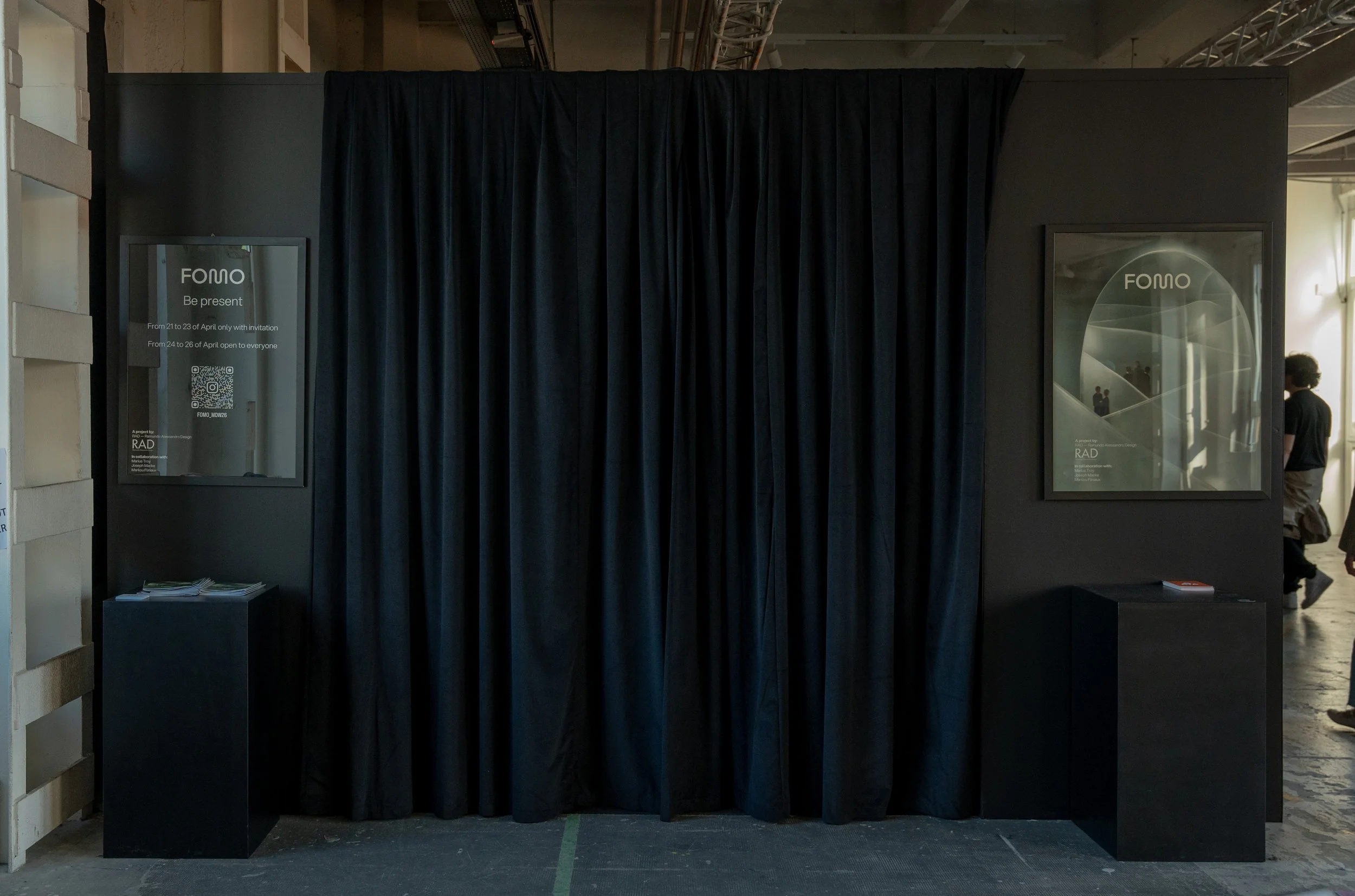
FOMO, Base Milano Design Week 2026
Joseph Macke
Art and Science Conductor, HEKA Studio
Anyone who enters FOMO finds themselves suspended between disillusionment and vulnerability. The visitor quickly realises they are being confronted, not by a static object, but by the ghost of their own expectations. These expectations were whispered to them long before they arrived, meticulously designed through digital stimuli and a choreographed social media campaign.
If the modern individual is a “durchdringlicher Hohlkörper” (Sloterdijk, 1998), a permeable entity through which influences continuously flow, then the installation serves as a psychic filter. It holds up a mirror to contemporary society, showing that our inner selves are not closed rooms, but permeable spaces shaped by shared atmospheres and relations. In the digital world, the screen is a shield; here, the screen is an eye looking back. The comfortable safety of the observer is gone, replaced by the reality of being a vessel through which shared anxieties and social pressures flow.
The Observed Observer
The visitors realise that they did not enter an installation that they can perceive and grasp. Instead, they find they are part of the installation without having noticed it. They are just as much the observed as they hoped to be the observer. It introduces a mirror, a reflection of a temporal paradox: what was whispered to them remains “not-yet”, while what they encounter is already “no-longer” (cf. Lyotard).
The installation represents a deliberate break. It subverts the "instagrammable" dream, the desire for visual proof of belonging, a “cloak of culture” one can drape around oneself. Behind the screen, we imagine ourselves as voyeurs of a desirable world, but in this space, the choreography is exposed. This misalignment is the art itself. It is an intentional disruption of the cultural cloak we voluntarily hide our authentic selves under. We submit to these power structures (cf. Han, 2017), but we must ask: who wove the cloak? And why did we put it on so willingly?
Swarm Intelligence or Extraction?
It would be too simplistic to look for the solution in peer pressure. That borders on shirking responsibility. It is more nuanced than that (cf. in this context Kersten, 2019). Humans are social beings, we crave participation. Yet, we have allowed the definition of participation — from Latin pars (part) and capere (to take) — to shrink into mere "taking a share." We fight for a slice of the "attention pie", a scarce resource managed by the venture capital industry (Wenger, 2025). Why don’t we see our role as social beings as a task of contribution, as a supporting pillar for society?
While earlier societies imagined the heart as a monarch distributing life (Sloterdijk, 1998), our digital era has replaced circulation with extraction. We see this mirrored in the housing crisis (Harvey, 2012): the system thrives on the tensions of shortage. Fear of Missing Out is the emotional fuel for this machinery. It tells us that if we do not rush to the distribution centre (the city, the platform, the trend) we will be left behind.
The Choice to be "Left Behind"
We live in a societal model shaped by the distribution of resources (cf. Kelsen, 1952; Pistor, 2019). That in itself is not problematic. It becomes so when parts of society profit from the struggle over resources, with people competing for what they believe is rightfully theirs, in constant fear of being left behind.
But what does “left behind” mean? Places differ not only economically but atmospherically, in the kinds of relations and resonances allow. Having lived in big cities for about 13 years, I have shifted my focus back to the countryside where I grew up. Rent is affordable, people are friendly, and the tranquility of nature is priceless. Genuine connections with neighbours help solve everyday problems. Community is lived here, not just discussed.
Does “left behind” perhaps also mean “left in peace”, “left within structures” where capitalist patterns have not yet taken deep root? Where social relations have not yet been fully commodified (cf. Hyde, 2007)? What drives me to question whether this is the right place? The answer is clear: FOMO. The idea that a better society awaits in the city, a sphere more fitting to my world (cf. Sloterdijk, 2014). More cultured, wilder, freer.
Is that sphere real, or am I submitting to a struggle for resources that only benefits the system? Have I been conditioned to prefer a “cloak of culture” that scratches more than it warms?
Before drifting further into abstract digital environments, we must step back and allow ourselves to be “left behind”. This is not failure, but a necessary return: a chance to re-anchor in the bodily here and now. We must grow bonds between us and roots within the terrestrial (in the sense of Latour, 2018).
We need such atmospheres, such spaces of freedom that remain undefined. As Böhme (1995) suggests, atmospheres are not objects of perception but affective fields in which perception takes shape. Supposed digital “spaces of freedom” do not actually offer this; they are already taken. The conceptual proximity between the Latin capere (to take) and capitalism is perhaps not entirely accidental: these spaces are occupied by structures of extraction and algorithmic anticipation.
References
Böhme, Gernot. Atmosphäre. Essays zur neuen Ästhetik. Frankfurt am Main: Suhrkamp, 1995.
Han, Byung-Chul. What Is Power? Cambridge: Polity Press, 2017.
Han, Byung-Chul. The Spirit of Hope, Cambridge: Polity Press, 2024.
Harvey, David. Rebel Cities. London: Verso, 2012.
Hyde, Lewis. The Gift: Creativity and the Artist in the Modern World. London: Vintage, 2007.
Kelsen, Hans. What is Justice. Lecture University of California, Berkeley — UC Berkeley Campus, 1952.
Kersten, Jens. Schwarmdemokratie: Der digitale Wandel des liberalen Verfassungsstaats. Tübingen: Mohr Siebeck, 2017.
Latour, Bruno. Down to Earth, Cambridge: Polity Press, 2018.
Lyotard, Jean-François. Philosophie und Malerei im Zeitalter ihres Experimentierens. Berlin: Merve Verlag, 2008.
Pistor, Katharina. The Code of Capital: How the Law Creates Wealth and Inequality. Princeton University Press, 2019.
Sloterdijk, Peter. Spheres I – Bubbles, Berlin: Suhrkamp, 1998.
Sloterdijk, Peter. Spheres II – Globes, Berlin: Suhrkamp, 2014.
Tuan, Yi-Fu. Space and Place: The Perspective of Experience, Minneapolis: University of Minnesota Press, 1977
Wenger, Albert. OMR Podcast (#792), 2025
FOMO, Base Milano, 2026 (Link)